What Makes a Paver Patio Sit Flat for Twenty Years
The pavers on top get all the attention. The four inches underneath them decide whether the job lasts.
September 10, 2026 · 3 min read
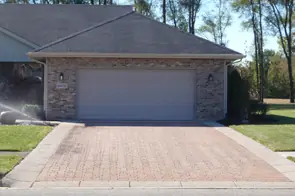
Two paver patios can use the identical paver, the same colour, the same pattern, and end up completely different after five winters. One stays flat enough that a marble would sit still on it. The other has joints opening up, edges kicking out, and low spots holding water after every rain. The paver on top is almost never why. The difference lives in the base underneath, the edge restraint at the perimeter, and the joint sand between each stone, none of which is visible once the job is finished and everyone assumes it was done the same way.
Base depth is not optional, and it is not guesswork
A paver surface needs a compacted aggregate base under it, and how deep that base needs to be depends on what sits on top of it afterward. A patio that only ever carries foot traffic needs less depth than a driveway that carries a vehicle every day. Skimping on base depth to save a day of excavation is the single most common reason a driveway that looked perfect at handover starts to rut and settle under tyre weight within two or three years, because there was never enough compacted material there to spread the load.
Compaction, not just the material itself
Dumping the right aggregate in the trench does nothing on its own. It has to go down in lifts, thin layers, each one run over with a plate compactor before the next lift goes on top. A base that is poured in one thick layer and compacted only on the surface looks solid the day it is built and then keeps settling for years afterward as traffic slowly compacts what should have been compacted before a single paver went down. That slow settling is what shows up later as a soft spot or a low corner that never used to be there.
Edge restraint holds the whole field together
Pavers are not glued to each other. What keeps a paver field tight is the restraint at the edges, a rigid or flexible edging pinned into the base along the entire perimeter, holding every paver in the field against the ones next to it. Without solid edge restraint, the outer rows start to creep outward under normal foot or vehicle traffic, and once the edge moves the joints across the whole patio start to open, one row at a time, working inward from the perimeter over a season or two.
Joint sand does more than fill the gap
The sand swept into the joints between pavers is what locks each stone against its neighbours and stops individual pavers from rocking under load. Joints that were never fully filled, or that lose their sand over a few years of rain and snowmelt washing through them, let individual pavers move independently instead of acting as one continuous surface. Once pavers can move on their own, they start to rock, chip at the edges, and settle unevenly, all from a problem that started as nothing more than a thin joint.
Freeze and thaw is the real exam
None of this matters much in a climate that never freezes. In Rockford it matters every winter. Water that gets into an undercompacted base or an open joint expands when it freezes, and that expansion is what actually lifts a section of patio or driveway out of level, not the weight of anyone walking or driving on it. A base built right sheds that water instead of holding it, which is the entire reason a well-built patio survives freeze and thaw cycle after cycle while a poorly built one starts heaving by its second or third winter.
- Compacted aggregate base, built in lifts, not one dumped layer
- Depth matched to the load: foot traffic patio versus vehicle driveway
- Rigid edge restraint pinned along the full perimeter
- Joints fully swept and settled with sand, not just topped once
A & T Lawncare and Landscaping builds brick paver patios, walks and driveways around Rockford with this base work done properly the first time, because redoing a driveway costs a lot more than building it right once. The evaluation and estimate is free, call (815) 509-4566 to have someone walk the site with you.
A & T Lawncare and Landscaping, Inc., (815) 509-4566
Call (815) 509-4566More articles
Why Retaining Walls Lean and Bow in Rockford's Clay
A bowing retaining wall is almost never a block problem. It is a water problem that started years before anyone noticed.
Why the Grade Gets Settled Before Anything Gets Planted
The prettiest planting plan cannot fix a yard that was never graded to move water away from the house.