Why Retaining Walls Lean and Bow in Rockford's Clay
A bowing retaining wall is almost never a block problem. It is a water problem that started years before anyone noticed.
September 10, 2026 · 3 min read
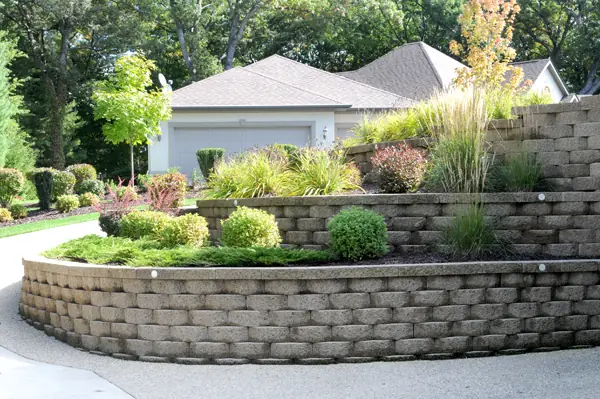
A retaining wall that went in straight three summers ago and is leaning now did not fail because the block was bad. Concrete block, natural stone, timber, whatever it is built from, the face of a wall almost never gives out on its own. What fails is what nobody can see: the soil, the drainage, and the base underneath it. In Rockford, that means understanding the clay this whole region sits on, because the clay is doing most of the work, good or bad, long before anyone notices a lean.
How northern Illinois clay actually behaves
Clay holds water instead of letting it pass through the way sand or loam would. When it takes on water it swells, and when it dries out it shrinks and cracks. That swell and shrink cycle repeats every wet spring and every dry August, and behind a retaining wall it turns into direct pressure on the back face of the wall, not just the weight of the soil sitting there but the expansion pushing outward as it saturates. A wall built to hold back dry soil and a wall built to hold back saturated, swelling clay are not the same engineering problem, even if they look identical from the sidewalk.
What drainage behind the wall is actually for
A properly built wall is not solid dirt all the way to the face of the block. Behind it there should be a column of clean, compactable gravel, not the native clay, wrapped in geotextile fabric so soil fines cannot migrate in and clog it. That gravel gives water somewhere to go besides sideways into the wall. Weep holes or a perforated drain tile at the base carry that water out to daylight instead of letting it pool against the footing all winter. Skip that layer, or backfill with the same clay that came out of the trench, and the wall is holding back full hydrostatic pressure every time it rains, with nowhere for the water to release.
Freeze and thaw finishes the job
Water trapped behind a wall in October is a slow problem. Water trapped behind a wall in January is a fast one. Saturated clay that freezes expands again, on top of the swelling it already does when wet, and that expansion pushes hardest right where a wall has the least resistance to give, the upper courses. A wall that was merely under strain in the fall can develop a visible bow over a single hard winter once ice gets into ground that was never given a way to drain.
The part that decides whether the wall lasts: the base
Below the first course of any retaining wall there should be a compacted aggregate base, set below the frost line and built level or with a slight back-slope so the wall leans very slightly into the hill rather than away from it. A base that is too shallow, poorly compacted, or set on undisturbed clay instead of prepared aggregate will settle unevenly over a few seasons. Once one section of the base settles more than the section next to it, the wall above it twists rather than staying in a straight plane, which is exactly the kind of lean that gets worse every year rather than staying put.
What a leaning wall usually needs
Not every leaning wall needs to come out. A wall with a real drainage problem behind it but a sound base can sometimes be corrected by excavating behind it, adding proper gravel and drain tile, and resetting the upper courses. A wall that has moved because the base itself failed usually does need to come out and be rebuilt from the footing up, because there is no fixing what is underneath without starting over. The only way to know which situation is in front of you is to have someone dig a little and look, not guess from the sidewalk.
The useful thing to know is that a leaning wall is almost never a wall problem on its own. It is a water problem that the wall is reporting. Anyone who looks at it and talks only about resetting the block, without asking where the water behind it goes, is reading the symptom and skipping the cause.
A & T Lawncare and Landscaping, Inc., (815) 509-4566
Call (815) 509-4566More articles
What Makes a Paver Patio Sit Flat for Twenty Years
The pavers on top get all the attention. The four inches underneath them decide whether the job lasts.
Why the Grade Gets Settled Before Anything Gets Planted
The prettiest planting plan cannot fix a yard that was never graded to move water away from the house.